How to use an Ignition Coil
I had second thoughts about adding this page to my website, questioning wether it's such a good idea to encourage people to build their own cannons. But seeing the dangerous methods of ignition that some people use, I figure it's in the interest of safety for people to use a proper ignition system and trigger their cannons from a safe distance.
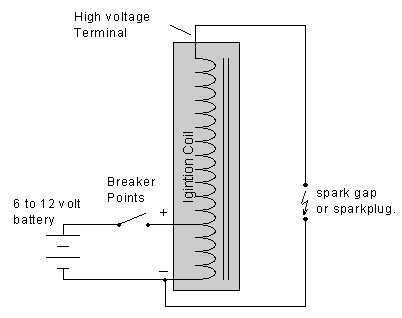
Operating principles
An ignition coil is essentially an autotransformer with a high ratio of secondary to primary windings. By "Autotransformer", I mean that the primary and secondary windings share some of the windings, so the transformer provides no isolation.The ratio of secondary to primary turns in an ignition coil is somewhere around 100:1. The ignition coil is operated directly off a 12 volt source. The coil doesn't quite operate like an ordinary transformer. An ordinary transformer will produce output current at the same time that input current is applied. An ignition coil actually does most of its work acting as an inductor. When the ignition coil is connected to the battery, the inductor is 'charged' with current. It takes a few milliseconds for the current to build up the magnetic field - this on account of reverse voltage caused by the increase in magnetic field. During this short charging period, maybe a thousand volts are produced at the high voltage terminal, not enough to produce a spark.
The actual spark itself is produced when the breaker contacts open. For an ideal inductor, the current and voltage relate by:
-
V = L dI
Where V is voltage, L is inductance (in henrys) and
dI is the rate of change of the current.
A less theoretical way of looking at it is that disconnecting the current source will cause the magnetic field in the coil to collapse (because nothing is forcing it magnetic anymore), and the rapid change of magnetic field in turn induces a large voltage in the windings.
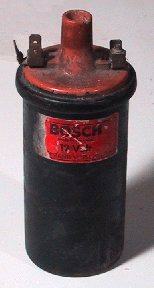
In an engine with four or more cylinders, the high voltage terminal of the coil is connected to the distributor, which is just a fancy high voltage rotating switch, for selecting which of the spark to connect the coil to. This is much cheaper than having one ignition coil for each cylinder. However, the whole arrangement is finniky, and most newer vehicles have a coil for each two cylinder, with each end of the coil sparking two spark plugs at once. This makes igntion coils like the one shown very difficult to find.
One thing that cars usually have that I didn't include in the circuit is a small capacitor across the breaker points, often called the "ignitor". This capacitor in cars before electronic ignition had a tendency to fail over time, so you may have heard people refer to it. The capacitor, together with the inductance of the coils, makes the coils resonate, which makes for a brighter spark. I don't fully understand why. It also heps protect mechanical contacts a bit, but cars these days no longer have mechanical ignition contacts. For the purpose of firing a cannon, it works well enough without one.
Using an ignition coil
 Using an ignition coil is fairly straightforward. Connecting 8 AA batteries in series provides
more than enough current and voltage. The AA batteries should last for a lot of firings, so
you might as well connect the batteries together by soldering wires onto them. Even a 9 volt
alkaline battery is sufficient to produce sparks with an ignition coil.
Using an ignition coil is fairly straightforward. Connecting 8 AA batteries in series provides
more than enough current and voltage. The AA batteries should last for a lot of firings, so
you might as well connect the batteries together by soldering wires onto them. Even a 9 volt
alkaline battery is sufficient to produce sparks with an ignition coil.
Connect the high voltage terminal of your ignition coil to the tip of the spark plug. The high voltage terminal is at the top center of the coil, with the deep socket. Use wire with good insulation - use at least the kind of cable used in a power cord, or something with thicker insulation. Its best to keep the wires a few centimeters apart, and away from any moisture. High voltage will find its way through any defects in the insulation. Keep the wires less than a meter long. Use another wire to connect the body of the spark plug to one of the terminals of the ignition coil (doesn't matter which one).
Next run two wires from the positive and negative terminals of the ignition coil. If you can't tell which is which, don't worry, swapping positive and negative won't make much difference. I recommend you use a long, but fairly thick wire for this, so that you can trigger your cannon from a safe distance. Your ears will thank you.
Connect the negative one to the battery. Then take the positive wire, and quickly swipe it over the other battery terminal. You should see and hear sparks at the ignition coil as you do this. Be sure to hold the wire you are swiping on the battery by just the insulation. If you do end up holding the conductor, and the batteries with the other hand, you will get a bit of an electrical jolt as you do this - though not enough to be dangerous.
A pair of screws screwed through the ABS pipe can be used instead of a spark plug. However, I found on my cannon that after just a couple of firings, there was enough moisture buildup in the cannon to prevent this arrangement from sparking. The moisture comes from the water vapour, which, along with carbon dioxide, is a product of the combustion. A proper spark plug will not short out as easily. To mount the plug, just drill a hole slightly smaller than the outside thread of the spark plug, and then screw the plug into the unthreaded hole in the ABS pipe. It should hold quite well that way. But even with a spark plug, moisture buildup from repeated firings can short out the plug. I recommend blowing fresh air through the cannon between shots.