Home | Index | Blog |
No Autistics Allowed:
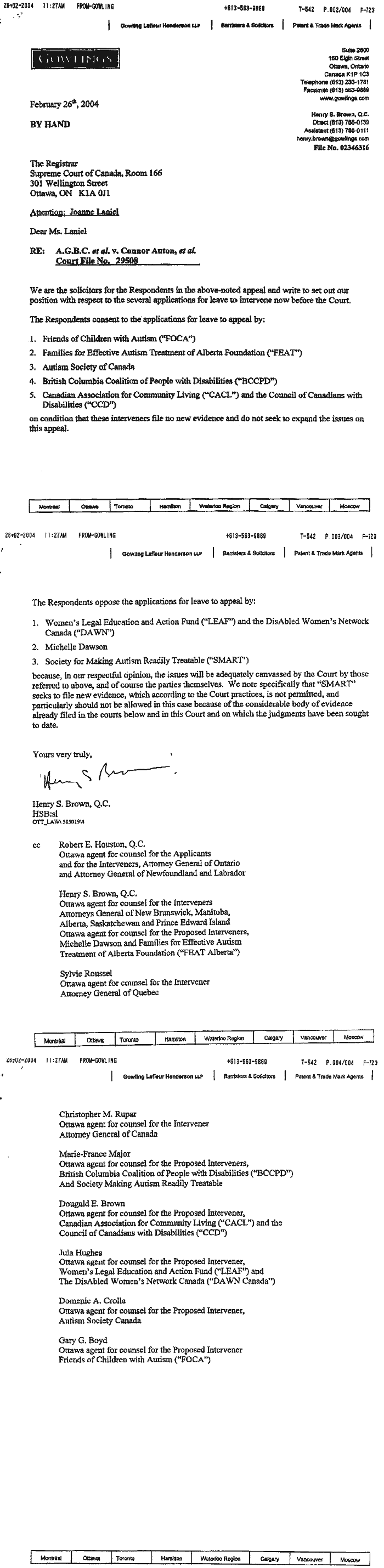
Autism Society Canada Speaks For Itself
The Auton Case: The Intervener's Factum | The Many Varieties of Being Written Off
AN AUTISTIC AT THE SUPREME COURT
The Auton Case: Application, Opposition, Order
1. THE APPLICATION:
(a) Application for Leave to Intervene
(b) Affidavit of Michelle Dawson
(c) Affidavit of Laurent Mottron
2. THE OPPOSITION:
(a) The Parents Oppose
(b) The Government Opposes
(c) Response to Opposition
3. THE ORDER
1(a). THE APPLICATION: Application for Leave to Intervene
File No.
29508
IN
THE SUPREME COURT OF CANADA
(On Appeal
from the Court of Appeal of British Columbia)
BETWEEN:
THE
ATTORNEY GENERAL OF BRITISH COLUMBIA and
THE MEDICAL SERVICES COMMISSION OF BRITISH COLUMBIA
Appellants
(Respondents on Cross-Appeal)
AND:
CONNOR
AUTON, an Infant, by his Guardian Ad Litem,
MICHELLE AUTON, and the said MICHELLE AUTON
in her personal capacity, MICHELLE TAMIR, an Infant,
by her Guardian Ad Litem, SABRINA FREEMAN,
and the said SABRINA FREEMAN in her personal capacity,
JORDAN LEFAIVRE, an Infant, by his Guardian Ad Litem,
LEIGHTON LEFAIVRE, and the said LEIGHTON LEFAIVRE
in his personal capacity, RUSSELL GORDON PEARCE, an Infant,
by his Guardian Ad Litem, JANET GORDON PEARCE
and the said JANET GORDON PEARCE in her personal capacity
Respondents
(Appellants on Cross-Appeal)
NOTICE OF APPLICATION FOR LEAVE
TO INTERVENE
(Rule 55, Rules of the Supreme Court of Canada)
NOTICE OF MOTION
TAKE
NOTICE that Ms. Michelle Dawson will apply to a judge of this Court,
at a date to be fixed by the Registrar, pursuant to Rule 55 of the Rules
of the Supreme Court of Canada, and for an order pursuant to subsection
19(5) permitting oral argument at the hearing of the appeal.
AND
FURTHER TAKE NOTICE that the following documents will be referred
to in such motion:
Tab 1: Affidavit of Michelle
Dawson
Tab 2 Affidavit and
curriculum vitae of Professor Laurent Mottron
and such further or other material as counsel may advise and
be permitted.
AND
FURTHER TAKE NOTICE that the said motion shall be made on the following
grounds:
1.
|
The Intervener is concerned the judgments
in the courts below both reveal a fundamental perception of autistic
individuals that is inconsistent with the notions underlying the prohibition
of discrimination found in fundamental Canadian values;
|
2.
|
Particularly, the judgments imply that
it is necessary for autistic individuals to survive in Canadian society
for them to be “treated” such that they become indistinguishable from
non-autistic individuals;
|
3.
|
This is inconsistent with the principles
elaborated by this Court in Eaton v. Brant County Board of Education,
[1997] 1 S.C.R. 241 which confirmed that it was society’s obligation
to adapt to the needs of individuals with disabilities, rather than the
opposite;
|
4.
|
A review of the record in the courts
below indicates that no testimony nor any representations were made
by autistic individuals who could have educated the court on the benefits
of certain autistic traits for the individual and society;
|
5.
|
The applicant is concerned that the
judgments of the court below appear to endorse the principle that a
particular type of treatment (Applied Behaviour Analysis) constitutes
a medically necessary treatment for autistic individuals such that the
failure of parents to provide that treatment or the failure of autistic
individuals to seek that treatment could constitute a deprivation of basic
medically necessary principles;
|
6.
|
If granted leave to intervene, the
Intervener would prepare a factum advocating that the government in fact
provide services necessary to assist autistic individuals to fully enable
them to participate as contributing members in Canadian society and that
a failure to do so constitutes discrimination.
|
7.
|
However, the Intervener would also
advocate that this Court establish the principle that any decisions regarding
“treatments” and services available to autistic individuals must seek and
obtain input from the autistic individuals themselves, in order for governments
to meet their obligations under section 15 of the Charter;
|
8.
|
In addition, the Intervener would argue
that, in the present case, no finding can be made under section 7 of
the Charter, since the factual underpinning required
for such a finding, evidence from the autistic individuals themselves,
or at the very least others similarly situated, is absent from the record
in this case;
|
9.
|
The Intervener proposes to file a factum
not exceeding twenty pages and oral argument of fifteen minutes;
|
DATED AT MONTREAL, this 11th day of February 2004.
Doug Mitchell
IRVING, MITCHELL & ASSOCIATES
4119 Sherbrooke Street West
Westmount, Quebec
H3Z 1A7
Tel: (514) 935-2725
Fax: (514) 935-2999
Email: dmitchell@irvingmitchell.com
Solicitors for the Applicant to Intervene
Michelle Dawson
ORIGINAL TO: THE REGISTRAR
COPIES:
1(b). APPLICATION: Affidavit of Michelle Dawson
File No.
29508
IN
THE SUPREME COURT OF CANADA
(On Appeal
from the Court of Appeal of British Columbia)
BETWEEN:
THE
ATTORNEY GENERAL OF BRITISH COLUMBIA and
THE MEDICAL SERVICES COMMISSION OF BRITISH COLUMBIA
Appellants
(Respondents on Cross-Appeal)
AND:
CONNOR
AUTON, an Infant, by his Guardian Ad Litem,
MICHELLE AUTON, and the said MICHELLE AUTON
in her personal capacity, MICHELLE TAMIR, an Infant,
by her Guardian Ad Litem, SABRINA FREEMAN,
and the said SABRINA FREEMAN in her personal
capacity,
JORDAN LEFAIVRE, an Infant, by his Guardian Ad
Litem,
LEIGHTON LEFAIVRE, and the said LEIGHTON LEFAIVRE
in his personal capacity, RUSSELL GORDON PEARCE, an
Infant,
by his Guardian Ad Litem, JANET GORDON PEARCE
and the said JANET GORDON PEARCE in her personal capacity
Respondents
(Appellants on Cross-Appeal)
AFFIDAVIT
OF MICHELLE DAWSON
I the
undersigned, Michelle Dawson, postal worker, residing and domiciled
at [street address], Montreal, Quebec, having been duly sworn hereby
depose and say:
1.
|
I am an autistic adult, having been
diagnosed with autism in 1993-94;
|
2.
|
I was not diagnosed as a child, not
because I was different from the infant petitioners in these proceedings,
but because early diagnosis of autism was not available at the time
and place I was a child;
|
3.
|
Contrary to the portrait presented
of autistic individuals in both the judgments in the courts below, and in
the proceedings, I am intelligent; I speak and communicate clearly.
I have held employment with Canada Post as a mail carrier for over fifteen
years. My employment record is exemplary.
|
4.
|
In addition, in the past two years,
I have worked extensively with Dr. Laurent Mottron, a respected expert
in autism, in assisting him to better understand the nature of autism.
|
5.
|
The judgments in the courts below paint
a dramatic picture of the “doom” that autistic individuals are destined
for in the absence of treatment. Madam Justice Allan concluded:
Unless
their condition is successfully treated, almost all autistic children
are doomed to a life of physical, emotional, social, and intellectual
isolation and eventual institutionalization - a tragic outcome for the
children, their families, and society.
|
6.
|
In my view, this conclusion is a complete
misrepresentation, due probably to the fact that no autistic individuals
were asked to testify before Judge Allan. Most autistic individuals
have not in fact received “treatment”, myself included, yet they in no
way meet this description;
|
7.
|
While my autism causes many difficulties
for me in the course of my daily activities, my belief is that if Canadian
society were more tolerant of my disability, I could function much
more effectively as a member of Canadian society;
|
8.
|
Furthermore, I believe that because
of the features associated with autism, my autistic characteristics
provide me with certain strengths and advantages not available to “normal”
Canadians;
|
9.
|
I am extremely concerned that these
strengths are not appreciated by many parents and professionals dealing
with autism who view it as their role to make the autistic individual
“normal”;
|
10.
|
Similarly, not so long ago, it was
thought by many societies, scientists, and parents to be necessary to “treat”
homosexuality, with an early intensive behaviour intervention with the stated
goal of preventing or curing homosexuality.
References:
Rekers, G.A., Bentler, P.M., Rosen, A.C., and Lovaas, O.I. (1977). Child
gender disturbances: A clinical rationale for intervention. Psychotherapy:
Theory, Research and Practice, 14, 2-11.; Rekers, G.A., and Lovaas, O.I.
(1974). Behavioral treatment of deviant sex-role behaviors in a male
child. Journal of Applied Behavior Analysis, 7, 173-90. ; Rekers, G.A.,
Lovaas, O.I., and Low, B. (1974). The behavioral treatment of a "transsexual"
preadolescent boy. Journal of Abnormal Child Psychology, 2, 99-116.
|
11.
|
In fact, the researcher who developed
the program which the Respondents are seeking to have provided to their
children, Dr. Ivar Lovaas, appears to have been a proponent of this
“treatment” of homosexuality. In 1977 he wrote:
"For example,
it has been proposed that the only appropriate goal of the psychotherapist
dealing with a homosexual individual is to help him adjust to his homosexual
orientation and behavior. Some critics go so far as to suggest that
a referral to a "Gay Counseling Center" is even more appropriate, with
the goal of placing the individual in contact with others like himself.
We find this line of argument to be totally unacceptable and irresponsible
[…] Once parents and professionals have concluded that a boy has a gender
disturbance, a therapist cannot ethically refuse to
treat the child.”
Reference:
Rekers, G.A., Bentler, P.M., Rosen, A.C., and Lovaas, O.I. (1977). Child
gender disturbances: A clinical rationale for intervention. Psychotherapy:
Theory, Research and Practice, 14, 2-11. [at p 9]
|
12.
|
Likewise, the only approach advocated
in these proceedings to deal with autism is to treat it so as to render
autistic persons indistinguishable from non-autistic persons, and to
measure the progress and achievement of an autistic person by the standard
of to what extent the autistic resembles a non-autistic;
|
13.
|
In my view, this denies the very humanity
which the Charter is supposed to protect. Yet it is implicit
in the basis of the Respondents’ claim;
|
14.
|
This is demonstrated by another writing
of Dr. Lovaas, who in 1993 wrote about autistic persons:
“Instead,
the fascinating part to me was to observe persons with eyes and ears,
teeth and toenails, walking around yet presenting few of the behaviors
that one would call social or human. Now, I had the chance to build
language and other social and intellectual behaviors where none had
existed, a good test of how much help a learning-based approach could
offer."
Reference:
Lovaas, O.I. (1993). The development of a treatment-research project
for developmentally disabled and autistic children. Journal of Applied
Behavior Analysis, 26, 617-30. [at p. 620]
|
15.
|
In my view, this position denies the
autistic population and the individuals whose interests are sought
to be advanced in these proceedings, the very human dignity which the
Charter is supposed to protect.
It makes the assumption that autistic individuals can only be fulfilled
(and in fact can only be “human”) if they are moulded to meet society’s
expectation of what is “normal”.
|
16.
|
In addition, the claim in these proceedings
is that the failure to provide this particular treatment constitutes
a denial of Charter rights under section 7.
|
17.
|
The basic premise underlying this view
does not appear to have been questioned by either the parties or the
courts, yet it runs counter to the statement of this court in Eaton
v Brandt County Board of Education where this court stated:
The principal
object of certain of the prohibited grounds is the elimination of discrimination
by the attribution of untrue characteristics based on stereotypical
attitudes relating to immutable conditions such as race or sex. In the
case of disability, this is one of the objectives. The other equally
important objective seeks to take into account the true characteristics
of this group which act as headwinds to the enjoyment of society's benefits
and to accommodate them. Exclusion from the mainstream of society results
from the construction of a society based solely on "mainstream" attributes
to which disabled persons will never be able to gain access. Whether it
is the impossibility of success at a written test for a blind person, or
the need for ramp access to a library, the discrimination does not lie
in the attribution of untrue characteristics to the disabled individual.
The blind person cannot see and the person in a wheelchair needs a ramp.
Rather, it is the failure to make reasonable accommodation, to fine-tune
society so that its structures and assumptions do not result in the relegation
and banishment of disabled persons from participation, which results in discrimination
against them.
|
18.
|
Many autistic individuals, such as
myself, are not seeking to become indistinguishable from non-autistics.
What we require is understanding, appreciation and respect for the fact that
we are different, and that this difference can in fact be positive;
|
19.
|
In my view, this perspective, that
society should accommodate itself to the special characteristics of autistic
individuals, is absent from the judgments of the courts below and of the
pleadings of the parties;
|
20.
|
In addition, no autistic individuals
testified or participated in the process. Yet there are autistic
individuals who could have coherently and cogently explained the realities
of autism, with both its benefits and weaknesses to the courts.
|
21.
|
The courts were only left with the
perspective of parents and the state in what became an argument over who
was responsible to assume the costs of dealing with the disability;
|
22.
|
I believe that the perspective I could
bring to this Court would be of assistance to the Court and allow it
to have a fuller understanding of the issues before it;
|
23.
|
I know of no association or group seeking
to intervene in these proceedings who could bring the true perspective
of autistic individuals;
|
24.
|
While several groups and associations
exist to promote the rights of autistic individuals, in my experience,
they are usually dominated by parents and professionals, and very seldom
have any input from autistic individuals, even when the autistics seek
to participate in these organizations.
|
25.
|
The Supreme Court of Canada is the
highest court of the land and is being asked to consider and render a decision
which may affect the lives of many autistic individuals;
|
26.
|
I believe it is essential that the
perspective of at least one autistic individual be present before the court
before it makes a decision on this vitally important issue.
|
|
AND I HAVE SIGNED:
(S)
Michelle Dawson
__________________________________
MICHELLE DAWSON
|
Solemnly declared before me at Montreal,
this 11th day of February 2004
(S) Mary Eleftheriadis #148840
________________________________________
Commissioner for Oaths for the
judicial district of Montreal
1(c). APPLICATION: Affidavit of Laurent Mottron
File No.
29508
IN
THE SUPREME COURT OF CANADA
(On Appeal
from the Court of Appeal of British Columbia)
BETWEEN:
THE
ATTORNEY GENERAL OF BRITISH COLUMBIA and
THE MEDICAL SERVICES COMMISSION OF BRITISH COLUMBIA
Appellants
(Respondents on Cross-Appeal)
AND:
CONNOR
AUTON, an Infant, by his Guardian Ad Litem,
MICHELLE AUTON, and the said MICHELLE AUTON
in her personal capacity, MICHELLE TAMIR, an Infant,
by her Guardian Ad Litem, SABRINA FREEMAN,
and the said SABRINA FREEMAN in her personal capacity,
JORDAN LEFAIVRE, an Infant, by his Guardian Ad Litem,
LEIGHTON LEFAIVRE, and the said LEIGHTON LEFAIVRE
in his personal capacity, RUSSELL GORDON PEARCE, an Infant,
by his Guardian Ad Litem, JANET GORDON PEARCE
and the said JANET GORDON PEARCE in her personal capacity
Respondents
(Appellants on Cross-Appeal)
AFFIDAVIT OF LAURENT
MOTTRON
I, the
undersigned, Laurent Mottron, psychiatrist, residing and domiciled at [street
address], Montreal, Quebec, having solemnly affirmed, do hereby
state:
1.
|
I am presently a Professor of Psychiatry
in the Faculty of Medicine at the Université de Montréal;
where I have taught for the last 10 years a practising psychiatrist
at Hôpital Rivière des Prairies;
|
2.
|
During those years, I have concentrated
my research in the field of autism. I am also currently the director
of a laboratory which studies information processing in autism, as
well as a specialized clinic for the diagnosis of autism; and the leader
of several autism research projects funded by the Canadian Institutes
of Health Research. A copy of my curriculum vitae is attached as
Exhibit A-1 to this my affidavit;
|
3.
|
I met Michelle Dawson fortuitously
three years ago, because we were both featured on a television program
on Radio-Canada called “Enjeux”. This particular program focussed
on the issue of autism;
|
4.
|
While I have had many occasions to
work with autistic individuals during my career, few of them have taught
me as much as Ms. Dawson has.
|
5.
|
Ms. Dawson has a tremendous understanding
of both the difficulties faced by autistic individuals in our society,
as well as the tremendous inherent strengths of many of these individuals.
She also has a remarkable ability to present her views coherently and
cogently;
|
6.
|
In fact, in my view, her level of knowledge
about scientific issues related to cognition and learning in autism
exceeds that of most academics I work with.
|
7.
|
We recently proposed to her that she
be affiliated with our team, considering the quality of the input she
is able to provide on all the work done and the public positions taken
by this laboratory.
|
8.
|
We are in the process of supervising
two PhD projects directly inspired by her ideas.
|
9.
|
In sum, this extremely qualified person
has something to say and has to be carefully heard. Her opinions are
innovative, strongly grounded in scientific and factual knowledge, and
are the result of a very high standard of reflection.
|
10.
|
If my personal experience is a reliable
guide, I believe Ms. Dawson’s views, if attended to, would be of tremendous
assistance to this Court in dealing with a profoundly challenging subject;
|
|
AND I HAVE SIGNED:
(S) Laurent Mottron
__________________________________
LAURENT MOTTRON
|
Solemnly declared before me at Montreal,
this 11th day of February 2004
(S) Mary Eleftheriadis #148840
________________________________________
Commissioner for Oaths for the
judicial district of Montreal
2(a). THE OPPOSITION: The Parents Oppose:
(February 26, 2004)
RE: AGBC et al. v. Connor Auton, et al.
Court File No. 29508
“We
are the solicitors for the Respondents in the above-noted appeal and
write to set out our position with respect to the several applications
for leave to intervene now before the Court. […]
“The Respondents oppose the applications for leave to appeal
by: […] Michelle Dawson because, in our respectful opinion, the issues
will be adequately canvassed by the Court by those referred to above,
and of course the parties themselves. […]”
(the above is an excerpt; for the complete document
click here [136k])
2(b). THE OPPOSITION: The Government Opposes:
(March 1, 2004)
Re:
The Attorney General of British Columbia and the Medical Services Commission
of British Columbia v. Auton et al.
File Number
29508
[…]
“We
are in receipt of nine applications for leave to intervene in the above
captioned matter. The Appellant, Attorney General of British Columbia,
submits that the interests of many of the proposed interveners are so
conjoined that they should not be allowed to file separate factums, or
to make separate oral submissions, assuming the right to make oral submissions
is granted. The Attorney General further submits that several of the proposed
interveners, viz., DAWN Canada, the Society for Making Autism Readily
Treatable, and Michelle Dawson cannot provide a unique perspective on
the issues in this case and as such, their applications should be denied.
The position of the Attorney General with regard to each of the applications
is set out below. […]
“The proposed intervener, Michelle Dawson, indicates that she
is an adult diagnosed with autism. Michelle Dawson seeks to place before
this Court the perspective of an adult person with autism in respect of
certain comments made in the Courts below regarding people with autism
generally. Such a perspective was not before the Courts below. In the result,
this application should be denied. […]”
(the above is an excerpt; for the complete document,
click here [318k])
2(c). THE OPPOSITION: Response to Opposition
Direct
line: (514) 935-2725
dmitchell@irvingmitchell.com
March 5, 2004
BY TELECOPIER
The Registrar
SUPREME COURT OF
CANADA
Room 166
301 Wellington Street
Ottawa, Ontario
K1A 0J1
Attention: Joanne Laniel
Re: A.G.B.C. et al. v. Connor Auton
et al.
Court
File No.: 29508
_____________
Dear Ms. Laniel,
We are
the attorneys for Michelle Dawson in the above-noted appeal and wish to reply
to the submissions by both the Appellants and the Respondents in response
to Ms. Dawson’s Application for Leave to Intervene.
First of all, we are disappointed to note that both parties
who claim to be representing the interest of autistic individuals claim
that the intervention of an autistic individual would serve no useful
purpose for this Court. For the reasons that are in our Application
for Leave to Intervene we believe it would be extremely beneficial for
the Court to have the perspective of at least one autistic individual in
this hearing.
In addition, we note with some irony that while the Respondents
state that Ms. Dawson’s Application for Leave to Intervene should be
refused since it adds nothing to the matter, the Appellant takes the
position that Ms. Dawson’s intervention should not be granted since it
represents a perspective that was not before the lower courts.
In our view, the Respondent is right that the perspective represented
by Ms. Dawson’s intervention was in fact not before the courts below.
Furthermore, our view is that it is vital that such a perspective be
before the court and it is precisely because of this unique perspective
which Ms. Dawson’s intervention brings that the intervention should be
granted. This court has recognition in Harper that an individual
with a particular expertise and experience can make a valuable contribution
to the Court’s full understanding of the issues before it.
I trust this is satisfactory, and remain,
Yours very truly,
Doug Mitchell
DM/me
c.c.
|
Robert E. Houston
Lisa Mrozinski
Ed Van Bemmel
Sylvie Roussel
Christopher Rupar
Marie-France Major
Dougald Brown
Jula Hughes
Gary Boyd
Stephen Grace
Sarah Kraicer
|
Supreme Court of Canada
|
|
Cour suprême du Canada
|
March 17, 2004
|
|
17 mars 2004
|
ORDER
MOTION
|
|
ORDONNANCE
REQUÊTE
|
THE
ATTORNEY GENERAL OF BRITISH COLUMBIA and THE MEDICAL SERVICES COMMISSION
OF BRITISH COLUMBIA v. CONNOR AUTON, an Infant, by his Guardian Ad Litem,
MICHELLE AUTON, and the said MICHELLE AUTON, in her personal capacity,
MICHELLE TAMIR, an Infant, by her Guardian Ad Litem, SABRINA FREEMAN,
and the said SABRINA FREEMAN in her personal capacity, JORDAN LEFAIVRE,
an Infant, by his Guardian Ad Litem, LEIGHTON LEFAIVRE in his personal capacity,
RUSSELL GORDON PEARCE, an Infant, by his Guardian Ad Litem, JANET GORDON
PEARCE, and the said JANET GORDON PEARCE in her personal capacity
(B.C.) (29508)
LEBEL J.:
UPON
APPLICATIONS by the Canadian Association for Community Living and
the Council of Canadians with Disabilities, the British Columbia Coalition
of People with Disabilities, the Families for Early Autism Treatment
of Ontario, the Autism Society Canada, the Families for Effective Autism
Treatment of Alberta Foundation, The Women's Legal Education and Action
Fund and the DisAbled Women's Network Canada, Ms. Michelle Dawson, the Society
Making Autism Readily Treatable and the Friends of Children with Autism
for leave to intervene in the above appeal;
After reviewing the material filed in support, it appears that
not all these motions should be granted. I am of the view that the motion
of the British Columbia Coalition of People with Disabilities, which
belongs to the Canadian Association for the Autism Society of Canada,
fails to indicate any distinct perspective which would be of assistance
to the Court and should be dismissed. The applications of the Families
for Early Autism Treatment of Ontario and the Families for Effective Autism
Treatment of Alberta Foundation raise the same issues and the same perspectives.
They should be granted leave to intervene, but will have to file a joint
factum. The motion of the Society Making Autism Readily Treatable should
not be allowed as it seeks to introduce new issues and additional evidence
in the record. The other applications should be granted.
AND HAVING READ the material filed;
IT IS HEREBY ORDERED THAT:
|
The motion for leave to intervene of
the applicant, the Canadian Association for Community Living and the
Council of Canadians with Disabilities, is granted and the applicant
shall be entitled to serve and file a factum not to exceed 20 pages in
length on or before April 16, 2004.
The motions for leave to intervene
by the applicants, the Families for Early Autism Treatment of Ontario
and the Families for Effective Autism Treatment of Alberta Foundation,
are granted and the applicants shall be entitled to serve and file a
joint factum not to exceed 20 pages in length on or before April 16,
2004.
The motion for leave to intervene
of the applicant, the Autism Society Canada, is granted and the applicant
shall be entitled to serve and file a factum not to exceed 20 pages
in length on or before April 16, 2004.
The motion for leave to intervene
of the applicant, the Women's Legal Education and Action Fund and
the DisAbled Women's Network Canada, is granted and the applicant shall
be entitled to serve and file a factum not to exceed 20 pages in length
on or before April 16, 2004.
The motion for leave to intervene
of the applicant, Ms. Michelle Dawson, is granted and the applicant
shall be entitled to serve and file a factum not to exceed 20 pages
in length on or before April 16, 2004.
The motion for leave to intervene
of the applicant, the Friends of Children with Autism, is granted
and the applicant shall be entitled to serve and file a factum not to
exceed 20 pages in length on or before April 16, 2004.
The motions for leave to intervene
of the British Columbia Coalition of People with Disabilities and the
Society Making Autism Readily Treatable are dismissed.
|
The
requests to present oral argument are deferred to a date following the
receipt and consideration of the written arguments of the parties and
the interveners.
The
interveners shall not be entitled to raise new issues or adduce further
evidence or otherwise to supplement the record of the parties.
Pursuant
to Rule 59(1)(a) the interveners shall pay to the appellants and respondents
any additional disbursements occasioned to the appellants and respondents
by their intervention.
J.C.S.C.
J.S.C.C.
|